

Hunting tips & Blogs
Wildlife Habitat Plans for Hunting Landowners
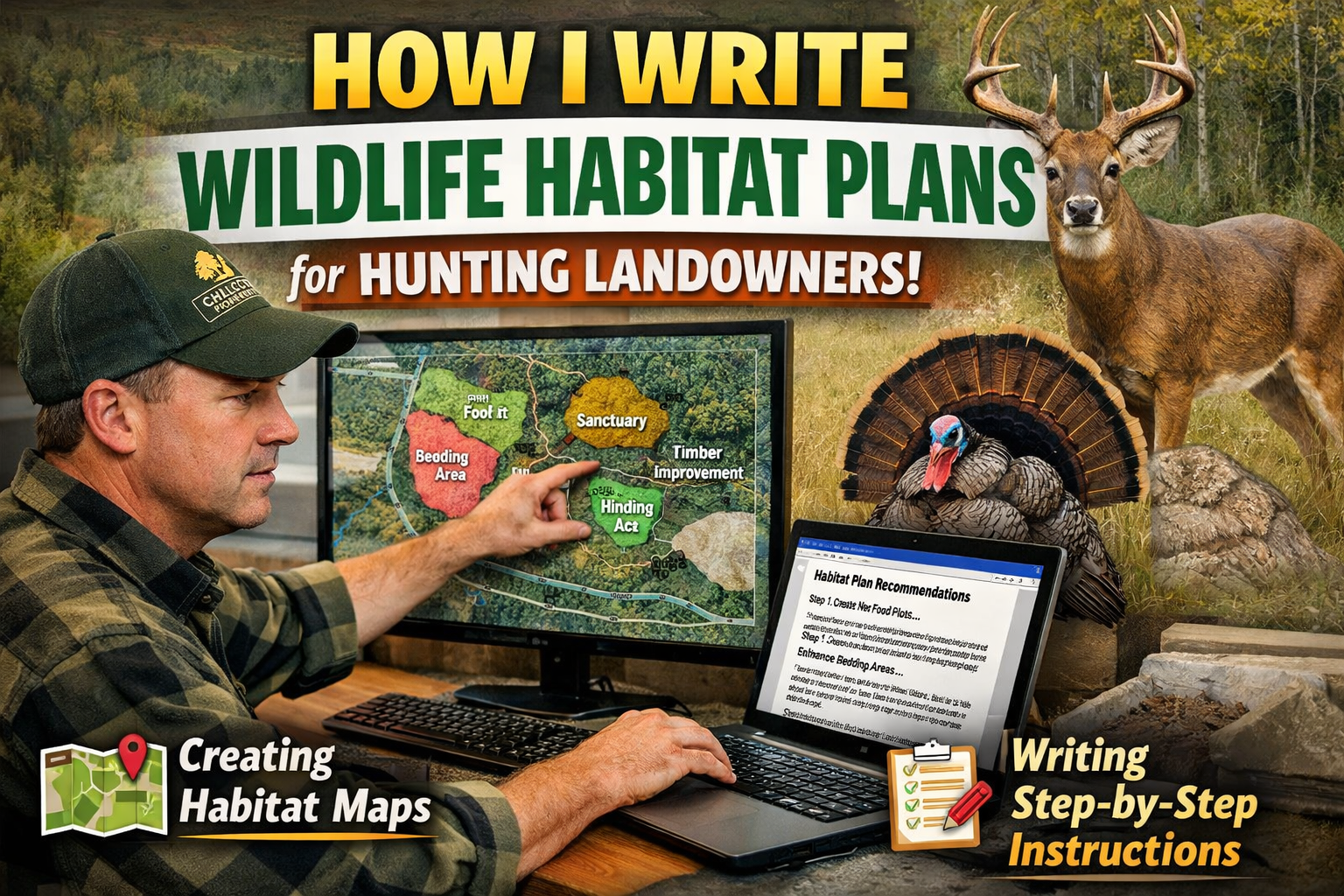
How I Design Properties That Actually Hold Deer
Most hunting properties fail for one simple reason: there was never a real plan.
Food plots get planted where they’re convenient, stands get hung where deer used to walk, and pressure pushes mature bucks onto neighboring properties. I see it all the time across Pennsylvania and other high-pressure deer states.
In this article, I’m going to walk you through exactly how I design wildlife habitat plans for hunting landowners, step by step. This is the same process I use when I’m hired to improve real properties—whether the goal is better archery hunts, late-season food security, or long-term land value.
Why Wildlife Habitat Plans Fail on Most Hunting Properties
Most habitat work fails because it’s piecemeal:
- A food plot here
- A random stand there
- A hinge cut without a purpose
- No sanctuary
- No understanding of wind or terrain
Deer don’t respond to individual projects.
They respond to systems.
A real wildlife habitat plan connects:
- Bedding
- Food
- Cover
- Travel
- Pressure
- Wind
If one of those pieces is missing, deer adjust—and usually leave.
Step 1: Reading the Land Before Touching Anything
Every plan starts with mapping and terrain analysis, not chainsaws or seed.
I use:
- High-resolution aerial imagery
- LiDAR to see through the canopy
- OnX Hunt for access, boundaries, and stand planning
LiDAR is especially important because it reveals:
- Ravines
- Benches
- Ridge lips
- High points
- Subtle terrain features deer naturally use
This lets me design movement instead of guessing.
Step 2: Identifying Bedding Areas That Actually Get Used
Bedding is the foundation of every successful hunting property.
On many farms, there’s plenty of open ground but nowhere deer feel safe. In those cases, I focus on creating bedding where deer want to be, not where it’s convenient for us.
Typical bedding strategies include:
- Hinge cutting low-quality timber on benches
- Individual bedding cuts along ridge lips
- Sanctuary blocks that are never hunted
- Switchgrass and shrub cover near food
If deer bed on the neighbors, you’ll never control daylight movement—no matter how good your food plots are.
Step 3: Sanctuary Design (The Most Ignored Tool in Whitetail Habitat)
Every property I design includes true sanctuary.
That means:
- No stands
- No access
- No pressure
In many plans, 30–50+ acres are designated as sanctuary depending on property size. Deer learn very quickly where they aren’t bothered—and that’s where mature bucks spend daylight hours.
Sanctuary isn’t wasted space.
It’s what makes the rest of the property huntable.
Step 4: Food Plots That Match Soil, Terrain, and Pressure
Food plots are tools—not decorations.
Instead of planting everywhere, I place food where:
- Soil quality supports it
- Deer can reach it safely
- Movement past stands is predictable
Common plot types in my plans include:
- Green forage plots on the best soils
- Corn and soybean plots strictly for deer
- Sorghum and legume blends for summer and fall
- Small kill plots near secure bedding
Every forage field gets a switchgrass edge to create screening and controlled entry.
Step 5: Stand Placement Based on Wind and Terrain
Most bad hunts happen because the stand was hung in the wrong spot for the wind.
Using terrain and LiDAR, I identify:
- Inside corners
- Ravine crossings
- Ridge transitions
- Downwind travel routes
Some stands are marked as:
- Early season only
- Rut only
- North/west wind only
Others are safe almost all season.
Good stand placement isn’t about where deer could walk—it’s about where they must walk.
Step 6: Native Shrubs, Switchgrass, and Edge Feathering
Cover is what keeps deer on your property during daylight.
In many plans, invasive shrubs are removed and replaced with:
- Native shrub plantings
- Wetland shrubs around low areas
- Switchgrass blocks with clover burn breaks
Field edges are feathered by dropping trees along boundaries, instantly improving:
- Security
- Movement control
- Daylight activity
These projects also qualify for NRCS cost-share funding when written correctly.
Step 7: Using LiDAR to Solve Wind and Access Problems
Wind is often the hardest problem on Pennsylvania properties.
Ravines, thermals, and elevation changes cause:
- Swirling wind
- False confidence
- Blown hunts
By studying LiDAR, I design:
- Safe access routes
- Stand approaches that avoid bedding
- Hunt timing recommendations
Some stands are intentionally labeled as rut-only due to wind instability—this saves landowners years of frustration.
Step 8: Writing the Plan for NRCS Funding (and Real Use)
Every plan I write serves two purposes:
- Clear instructions for the landowner
- NRCS-compatible language for funding applications
Plans include:
- Practice descriptions
- Applicable NRCS practice codes
- Implementation timelines
- Optional cost-share pathways
If funding is approved, great.
If not, the plan still works exactly as designed.
Turnkey Wildlife Habitat Management
Some landowners want the plan and do the work themselves.
Others want a turnkey solution.
I can:
- Write the habitat plan
- Help apply for NRCS funding
- Coordinate contractors
- Oversee implementation
Yes, it’s work.
Yes, it costs money.
But when it’s done right, your property hunts better for years.
Who This Is For
This approach works best for:
- Hunting landowners in Pennsylvania
- High-pressure whitetail states
- Properties with little existing bedding
- Farms dominated by open ground
- Landowners serious about long-term results
Final Thought: If You Fail to Plan, Plan to Fail
Every successful hunting property has one thing in common:
Someone took the time to plan it correctly.
If you’re interested in:
- A wildlife habitat management plan
- Applying for NRCS funding
- Or having everything handled from start to finish
Get in touch and we’ll talk through your property.
If you fail to plan, plan to fail.
Heres a youtube video on some plans I wrote recently: https://www.youtube.com/watch?v=ru1jkq4CtoI